
58 Views
Added
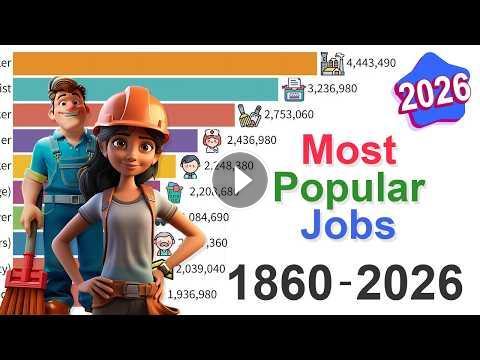
This visualization tracks the evolution of the most common occupations in the United States from 1860 to 2026, covering 166 years of labor market transformation from an agrarian economy, through industrialization and post-war expansion, to today's service, digital, and gig economy.Methodology:
The data presented tracks the Total Employed Individuals in the United States across specific, granular occupational titles. Broad sectors (like Manufacturing or Retail) were intentionally split into their specific, era-defining job roles (separating early Textile Workers from mid-century Auto/Steel Workers). Furthermore, strict coefficient multipliers were applied to modern data to isolate specific frontline workers from generic administrative bloat, and to account for the massive annual turnover (Total Unique Annual Workers) inherent to modern 1099 independent contractor roles (Gig Drivers and Social Media Creators), which standard W-2 snapshot data often undercounts.
Primary data pools:
Baseline workforce metrics for extinct and historical trades (Blacksmiths, Teamsters) were obtained using the US Census Bureau Decennial Reports (Occupational Classifications) and the Historical Statistics of the United States. For the 1860 data, the economic reality of the era is reflected by explicitly tracking the 3.9 million enslaved African Americans prior to the 13th Amendment. The Post-War & Service Boom data were aggregated using historical tables from the Bureau of Labor Statistics (BLS) and the Current Population Survey (CPS). Modern employment peaks were mapped strictly against BLS Standard Occupational Classification (SOC) codes to isolate job titles. The explosive rise of modern delivery, e-commerce, and gig labor was synthesized using IRS 1099 tax filing data and public corporate workforce disclosures from tech conglomerates (Amazon, Uber).
*****
Hi, I'm Sasha.
I crunch numbers, play with data, and create cool visuals. If you enjoy my work, a little support can get me a coffee and a cookie for my baby girl Eva ☕
- Tags
- statistics, history, trends
Up Next
Autoplay
-

Music Mix 2026 | Party Club Dance 2026 | Best Remixes Of Popular Songs 2026 MEGAMIX (DJ Silviu M)
-
06:12
Top 5 Best Transcription Jobs For Beginners 2024 (Best Transcriptionist Jobs)
-
Music Mix 2026 | Party Club Dance 2026 | Best Remixes Of Popular Songs 2026 MEGAMIX (DJ Silviu M)
-
05:11
LinkedIn Unveils Most In-Demand Jobs Skills in 2026
-
23:24
Economists react to weak September jobs report | CTV National News for Oct. 9, 2026
-
Music Mix 2026 | Party Club Dance 2026 | Best Remixes Of Popular Songs 2026 MEGAMIX (DJ Silviu M)
-
Ashley Vasquez: Working 2 Full Time Jobs, Party lifestyle, Retiring parents, and so much more!
-
06:03
India Overtakes the US in Global Growth Share in 2026, IMF Data Shows | Vantage with Palki Sharma
-
New Year Music Mix 2026 ♫ Best Music 2026 Of All Time ♫ Top Popular Songs ♫ Spotify mix 2026
-
08:33
FINISH THE LYRICS - 25 Most Popular Songs Ever | Most Popular 2023 Songs of all time | Music Quiz
-
Music Mix 2026 | Party Club Dance 2026 | Best Remixes Of Popular Songs 2026 MEGAMIX (DJ Silviu M)
-
23:23
Canada loses 25,000 jobs as unemployment rate rises | CTV National News for 11 for Feb. 6, 2026
-
IT Jobs in 2026 – No Hype, Only Truth | Reality of Tech Jobs
-
Layoffs Explained: Why Tech Jobs Are Disappearing in 2026 | Spotlight | N18G
-
Music Mix 2026 | Party Club Dance 2026 | Best Remixes Of Popular Songs 2026 MEGAMIX (DJ Silviu M)
-
00:13

HIPS DON’T LIE Tiktok Trend!❤️#shorts #short #trendingshorts
-
12:38

We've Been BOOed!
-
14:59

Estranho Anime Porno
-
05:31

The Zero Review Hentai: SINKAN
-
03:31

Luis Fonsi, Demi Lovato - Échame La Culpa
-
18:02

Luis Fonsi - Despacito (Lyric) - Meghan Trainor - All About That Bass, Like I'm Gonna Lose you (MIX)
-
04:49

Christina Aguilera - Fall In Line (Official Video) ft. Demi Lovato
-
38:00

LIFE BEYOND II: The Museum of Alien Life (4K)
-
31:08

Joe Rogan's Life Advice Will Change Your Life (MUST WATCH) | Joe Rogan Motivation
-
10:54

GET IT DONE - Best Motivational Speech Video (Joe Rogan Motivation)
-

*Sakura Cards Captor*- Voz OriginalMarcia Peña*---Yo Te Atrapo Tú Me Atrapas--- _Catch You Catch Me_
-
10:43:16

-
4:00:26

Summer Music Mix 2023
-
17:59

$20 Vs $700 Drink Test.. (epic fail cringe)
-
04:13

PSY - GANGNAM STYLE(강남스타일) M/V
 Loading...
Comments